TwinQuant: Learnable Subspace Decomposition for W4A4 LLM Quantization
Notes on TwinQuant (ICML'26), which learns its low-rank/residual decomposition directly against quantization error rather than real-valued energy, via a fused dual-component kernel.
Notes on TwinQuant (ICML’26), a W4A4-INT post-training quantization method for LLMs. Where prior low-rank + quantization approaches (SVD, LoRA-style) minimize the real-valued energy of the residual, TwinQuant instead learns the decomposition itself to directly minimize the quantization error of both the residual and the low-rank components — via a joint optimization over two learnable transforms, plus a fused dual-component kernel so the extra low-rank branch doesn’t cost latency. (ref: arXiv:2606.01556)
01. Introduction
Prior work decomposes the weight via SVD, then separately trains quantization parameters (scale, clipping threshold) on top. Earlier approaches — SpinQuant, QuaRot — apply scaling and (mostly Hadamard) matrix transformations to redistribute weights and activations before quantization, but this incurs high overhead since it requires reading across different coordinate systems.
The more recent SVDQuant (see the previous post) (1) smooths activations first, (2) assumes quantization hardness has moved from activations to weights, and (3) finds the residual $R$ by decomposing the weight into a low-rank outlier component. But SVDQuant (1) incurs high overhead when the rank is large, and (2) leaves a large residual with high accuracy loss when the rank is small.
TwinQuant introduces learnable subspace decomposition: it learns how to split each weight into two complementary, quantization-friendly components under a fixed rank budget.
Q. What is the learnable parameter here? How is it computed? A. Two matrices, $G$ and $Q$ — covered in §04.
Q. Can training itself become a source of overhead? A. Yes — that’s one of the paper’s stated limitations (§06).
Note that “learnable” here does not mean training quantization parameters like scale or clipping thresholds — TwinQuant doesn’t tune those via a full calibration forward pass. It means learning the decomposition itself.
02. Background
Integer quantization formula:
\[Q_x = \mathrm{round}\left(\frac{x}{\vec{s}}\right), \quad \vec{s} = \frac{\max(|X|)}{q_{max}}\]Note: TwinQuant addresses integer quantization only. Figure 4 (§04) shows INT32 accumulation for Tensor Core MMA.
A. Low-Rank Decomposition
SVDQuant applies SVD to the scaled weights, absorbing most of the outlier components into a low-rank component while quantizing the remaining residual to low precision:
\[\hat{Y} = \hat{X}\hat{W} \approx Q(\hat{X})UV + Q(\hat{X})Q(R)\]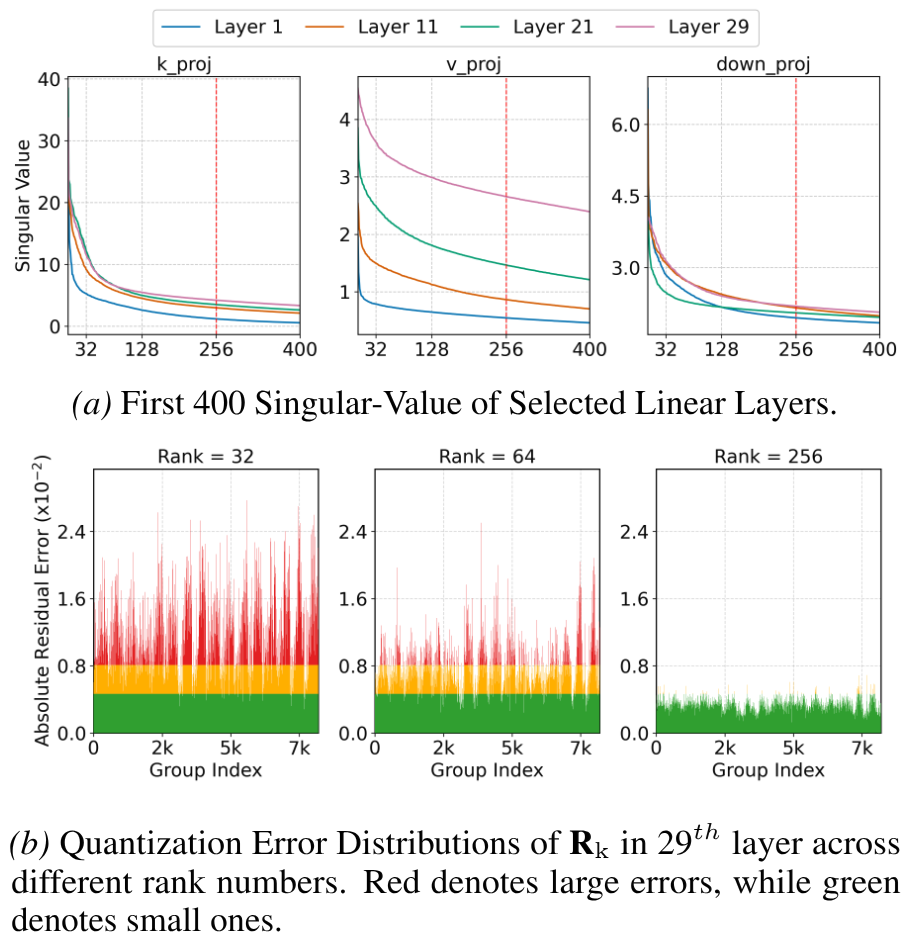
Note: Decay here means how rapidly singular values shrink when sorted by index. Panel (a) shows slow decay — even though the leading singular values drop off quickly, non-negligible ones remain deep into the tail.
If singular values existed only at the front, a handful of leading ranks would capture nearly all the outliers — that’s the case for the diffusion-model weights SVDQuant targets, but not for LLM weights.
B. Parameter-Efficient Learnable Quantization
Slow spectral decay is the crux of the problem TwinQuant sets out to fix (§03), and the fix has to stay parameter-efficient — the whole point of a low-rank branch is a small rank budget, so any learnable component added on top can’t reintroduce the cost it was meant to avoid.
03. Motivation
A. Observation 1: LLM Weights Exhibit Slow Singular-Value Decay
See the note under Figure 1 (§02.A).
B. Observation 2: Slow Spectral Decay Creates a Rank–Overhead Dilemma
Slow decay directly affects residual quantization error. Decomposing into a small rank $r$ leaves large truncated (outlier) values in the residual, so the approximation error grows. Minimizing residual quantization error therefore demands a large $r$ to keep more singular values in the low-rank branch — but a large $r$ is exactly the overhead SVDQuant struggles with. This is the dilemma TwinQuant is built to escape.
04. Method
A. Dual Decomposed Subspaces
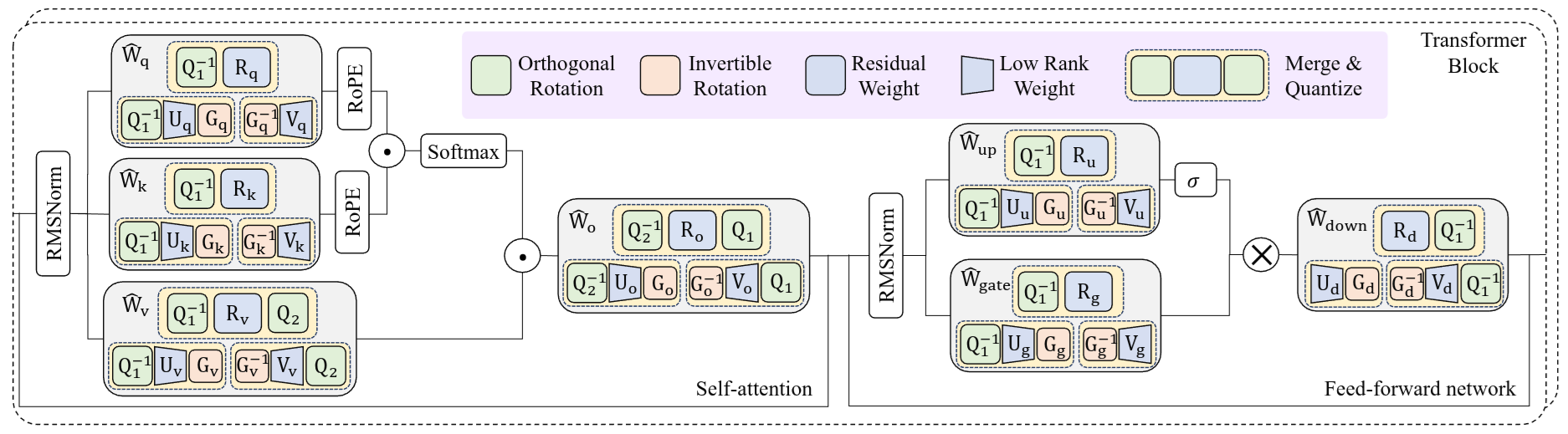
TwinQuant reshapes the numerical distribution of the low-rank components, the residual, and the activation, so as to minimize the quantization error directly:
\[Error = \hat{Y} - Q(\hat{X})\left[Q(U)Q(V) + Q(R)\right]\]Assuming quantization noise is mutually independent across terms, this error decomposes into three sources: activation, low-rank weight (outliers), and residual weight (non-outliers). These three are jointly connected, so quantizing them under a fixed decomposition — as SVDQuant does — can be sub-optimal.
TwinQuant introduces two learnable transforms to address this jointly:
- Global orthogonal matrices $Q$: reduce activation and residual error by reshaping their distributions. Being orthogonal, they can be fused into the preceding RMSNorm (as in QuaRot), so they add no runtime overhead.
- Layer-specific invertible matrices $G$: redistribute the low-rank factors $U, V$. These are invertible rather than orthogonal, trading that structural guarantee for more flexibility.
“Learnable” specifically means: feed calibration data iteratively and compute the reconstruction loss (Eq. 6/9 in the paper) via a forward pass, then update $G$ and $Q$.
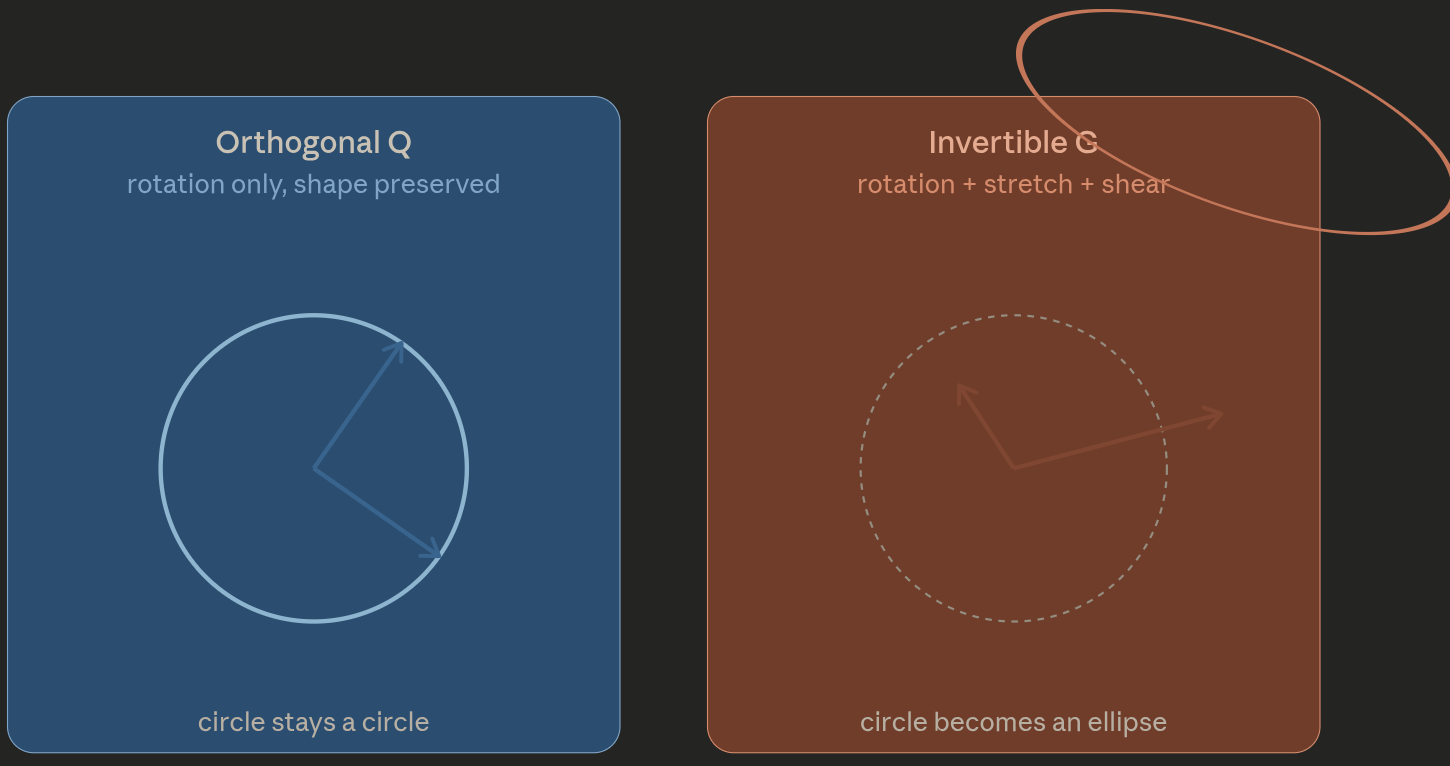
Q. The orthogonal transform should be cheap since it’s just a transpose op — but doesn’t the invertible transform cost more, since it’s a full matmul? A. Both $G$ and $Q$ are computed offline, in the calibration stage — so neither adds inference-time overhead.
B. Joint Optimization on Stiefel and General Linear Manifolds
Since the error involves products of multiple learned matrices ($G$, $Q$), the optimization is non-convex with multiple local minima. Naively optimizing all of them jointly from the start is unstable — so TwinQuant structures the optimization in stages.
Hybrid Manifold Optimizer
TwinQuant optimizes with gradient descent — specifically Cayley SGD (to keep $Q$ on its orthogonal/Stiefel manifold) combined with plain momentum SGD for $G$. Nothing exotic beyond respecting each matrix’s structural constraint during the update.
Stage-Wise Decoupling Training
Jointly optimizing $Q_1, Q_2, G$ re-parameterizes the low-rank factors as:
\[U' = Q^{-1}UG, \quad V' = G^{-1}V\]This re-parameterization couples $Q$ and $G$ bilinearly, which makes the joint problem non-convex and hard to optimize directly. To escape that coupling, TwinQuant trains in three stages:
- Global Alignment — optimize $Q_1, Q_2$ only.
- Invertible Adaptation — optimize $G$ only, with $Q$ fixed.
- Joint Refinement — fine-tune $Q$ and $G$ together.
C. Dual-Component Kernel Design
SVDQuant keeps the low-rank (outlier) branch at high precision. TwinQuant instead quantizes both branches — which means the low-rank branch now needs its own efficient kernel path.
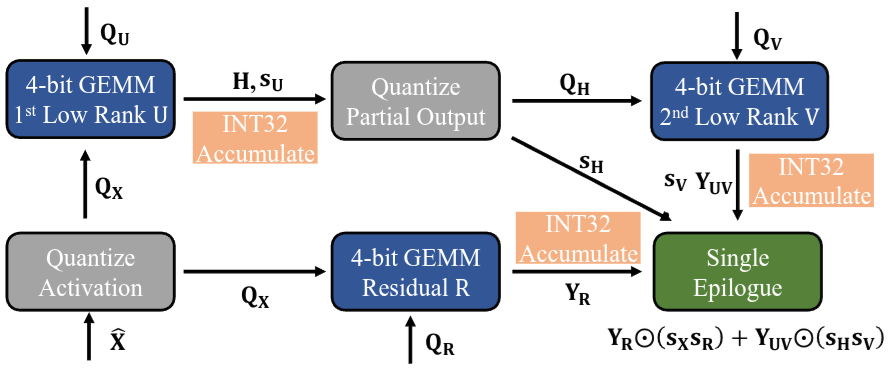
Q. Why accumulate in INT32 instead of staying 4-bit? A. To avoid overflow — a 4-bit×4-bit product (up to 15×15 = 225) already exceeds what 4 bits can represent.
Unlike the residual path, which is a single GEMM ($X \cdot R$), the low-rank path (outliers) is a two-stage product ($U \cdot V$). The first GEMM produces an INT32 accumulator — not directly 4-bit-compatible. Naively writing that intermediate result to global memory, then reloading and re-quantizing it for the second GEMM, means extra kernel launches and expensive memory traffic.
Fused Two-Stage Low-Rank Pipeline
To avoid that round-trip, TwinQuant re-quantizes the intermediate result on-chip, in shared memory, without ever writing it back to global memory. The residual GEMM quantizes activations concurrently, and both paths feed a single shared epilogue.
06. Limitations and Future Work
Authors mentioned there are four limitations at TwinQuant:
- Experiments focus on dense models only — no MoE evaluation.
- The fused kernel targets the NVIDIA Ada generation (RTX 4090, L20) — no Hopper or Blackwell support.
- No validation on long-context datasets.
- The learnable transform depends on calibration data, and the offline optimization stage takes a long time.
07. Conclusion
TwinQuant is a W4A4-INT PTQ workflow built around learnable subspace decomposition. A three-stage optimization minimizes quantization error jointly across activation, low-rank, and residual terms, and a fused dual-component kernel keeps the now-quantized low-rank branch from adding latency.
08. Personal Comments
TwinQuant is a W4A4-INT (quantize both weight and activation to integer 4-bit) methods for LLM inference. It approaches with decomposition, based on unitary-matrix in linear algebra.
Motivated by SVDQuant, it uses SVD with more detailed decomposition to identify quantization error. However, since architecture behavior (diffusion vs. transformer-based llm) is different, it is hard to directly apply SVD, following SVDQuant. Therefore, TwinQuant introduces two learnable (updated within calibration stage) matrix.
Naive implementation would suffer from two-stage issue decreasing throughput (multiple memory read/write), so TwinQuant introduced fused kernel to prevent.
However, it’s experiments are tiny scoped and limitations are left without ablations.
For example, authors mentioned “no validation on long-context datasets”, but didn’t experimented with long-context datasets. There is no experiments to check robustness of learnable transform ($Q, G$), because it’s experimented within scoped environments.
Plus, since this paper doesn’t make oss code, it would be hard to understand $Q, G$ behavior in real production level.
References
- TwinQuant (ICML’26): arXiv:2606.01556
- SVDQuant (ICLR’25 Spotlight): see the previous post
- SpinQuant / QuaRot: rotation-based outlier mitigation for LLM quantization